
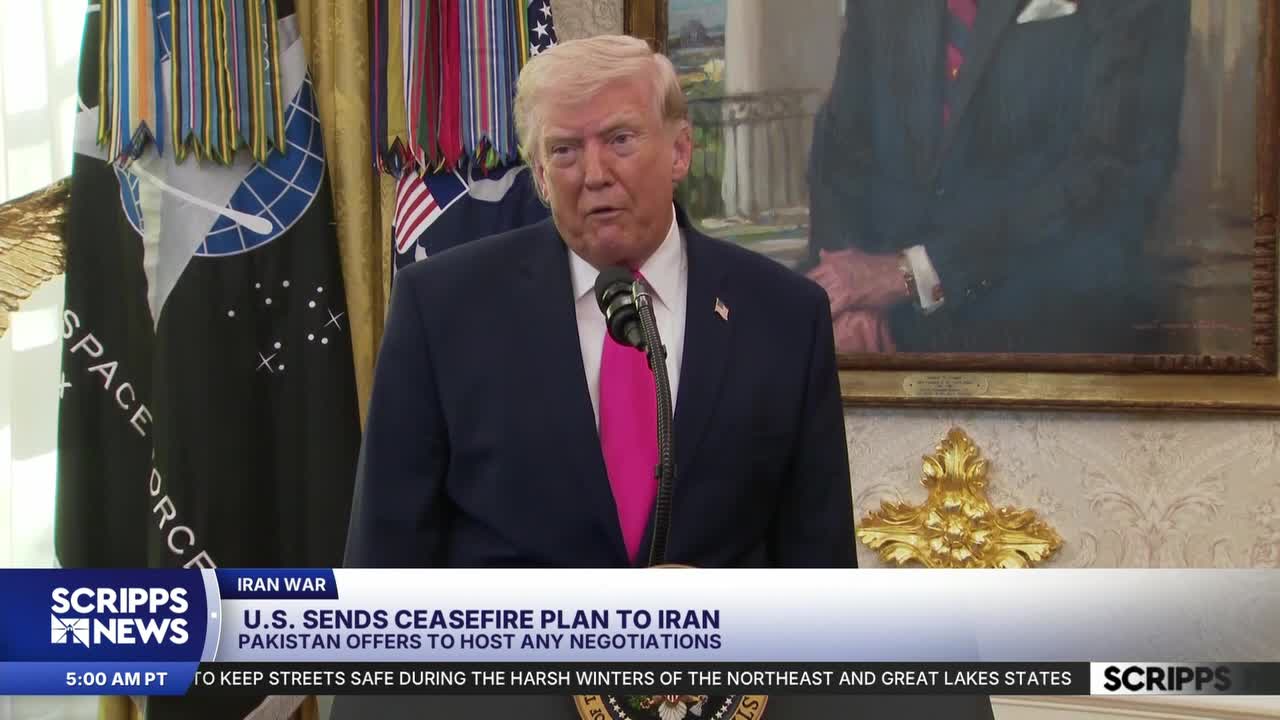


Iran has rejected America’s 15-point ceasefire proposal.
The proposal reportedly touched on sanctions relief, civilian nuclear cooperation, a rollback of Iran’s nuclear program, monitoring by the International Atomic Energy Agency, missile limits and access for shipping through the Strait of Hormuz, the narrow mouth of the Persian Gulf.
The Trump administration offered the plan to Iran as the U.S. appears to seek an end to the war even while more troops head to the Middle East. At least 1,000 troops from the 82nd Airborne Division will be sent to the Mideast in the coming days, three people with knowledge of the plans told The Associated Press. The Pentagon is also in the process of deploying two Marine units that will add about 5,000 Marines and thousands of sailors to the region.
RELATED STORY | Trump says US has ‘won’ war with Iran, but fighting continues
Press TV, like all of state TV channels controlled by hard-liners, offered its own five-point plan from the official who rejected the US proposal.
#Iran sets conditions for a ceasefire, rejecting recent U.S. proposals.
Key demands include:
Complete end to aggression
Guaranteed war reparations
Region-wide ceasefire for all fronts
Sovereignty over the Strait of #Hormuz
Full details in the attached image.#Ceasefire pic.twitter.com/fvcNI1FJQG— Consulate General of the I.R. Iran in Mumbai (@IRANinMumbai) March 25, 2026
It included a halt to killings of its officials, means to make sure no other war is waged against it, reparations for the war, the end of hostilities and Iran’s “exercise of sovereignty over the Strait of Hormuz.”
Those measures, particularly reparations and its continued chokehold over the Strait of Hormuz, likely will be unacceptable to the White House as energy supplies worldwide remain affected by the war.
The plan was submitted to Iran by intermediaries from the government of Pakistan, which has offered to host renewed negotiations between Washington and Tehran, a person briefed on the plan's contours but who was not authorized to speak publicly told The Associated Press on Tuesday.
Any talks between the U.S. and Iran would face monumental challenges. Many of Washington’s shifting objectives, particularly over Iran’s ballistic missile and nuclear programs, remain difficult to achieve, and it is not clear who in Iran’s government has the authority or would be willing to negotiate.
Iranian Foreign Minister Abbas Araghchi’s office said he has been discussing the war this week with several counterparts, but Mohammad Bagher Qalibaf, the speaker of Iran’s Parliament, denied Trump’s claim of direct talks and an Iranian military spokesperson declared that the fighting would go on.
RELATED STORY | The US evaluates its goals as President Trump signals productive Iran talks
Alluding to progress in talks, U.S. President Donald Trump claimed Iran shared an oil- and gas-related “present,” a day after telling reporters that the Middle Eastern nation is eager for a deal to end the war.
